
by Jeffrey C Kadlowec, Architect

Life Cycle Assessment
Biofuels—liquids derived from biomass—are an attractive alternative to fossil fuels when locally-produced as a renewable resource to reduce dependency on imported oil. Carbon neutrality could be achieved by balancing carbon dioxide from biofuel combustion with the photosynthesis during growth of biomass. Life cycle assessment (LCA), when combined with energy balance and net energy ratio, becomes a powerful tool to analyze and identify thermodynamic inefficiencies (Gheewala 2023). Used to study the impact of transportation fuels, LCA can compare the effects of biofuels against traditional fossil fuels.
Attributional LCA quantifies environmental burden of biofuels to develop strategies for minimize effects, while consequential LCA evaluates changes resulting from decisions and policies related to biofuels (Gheewala 2023). Partial equilibrium (PE) models, computable general equilibrium (CGE), multisector dynamics (MSD) models, and integrated assessment models (IAMs) are other ways to incorporate market effects, land use change (LUC), supply chain, or economic input-output (EIO) into the analysis. By estimating environmental impact across each stage of biofuel production, these models provide detailed results opposed to industry averages (Nematian 2025). This data is crucial for policy making, scientific research, and technological development by identifying hotspots with the greatest impact to promote the most effective improvements.
Biofuel Production
Biofuels are a promising form of renewable energy with second-generation types derived from non-edible biomass including agricultural and forestry residues, dedicated energy crops, and organic waste (Halysh 2025). These abundant sources reduce competition with food crops and support principles of a circular economy. Lignocellulosic biomass is primarily cellulose, hemicellulose and lignin, which are crystalline structure, branched polysaccharies, and hydrophobic barrier, respectively. Pretreatment and hydrolysis converts lignocellulose into fermentable sugars for biofuel production. Integration of biomass into the bioenergy system can reduce dependency on fossil fuels, improve waste management, and support transition toward a low-carbon economy.
Future of Bioenergy
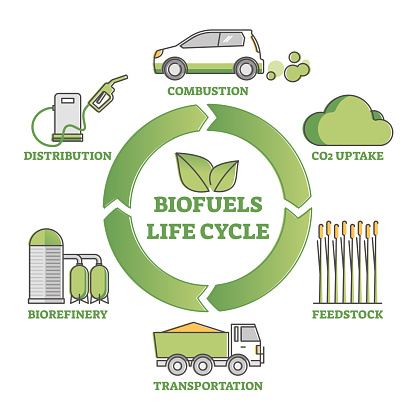
The cradle-to-grave life cycle of bioenergy typically involves production, pretreatment, conversion and usage for combined heat and power (CHP) systems. Third-generation technologies are not yet widely available commercially, and fourth-generation biofuels only exist at laboratory scale (Marks-Bielska 2025). LCA in support of policymaking will be instrumental toward implementation of environmental energy systems. Functioning economies require a continuous and stable supply of energy; and market development, employment, income growth, and social transformation are dependent upon energy security (Wang 2025). Countries that export energy rely on income and demand of raw materials, while energy importers benefit from diverse sourcing and optimal pricing. Threats to energy security fuel investment into new technologies, creating a growing industry sector. Sustainable energy security aims to make energy available and affordable through social acceptance of different types and sources.
References
Gheewala, Shabbir. (2023). Life Cycle Assessment for Sustainability Assessment of Biofuels and Bioproducts. Biofuel Research Journal, 37: 1810-1815. DOI: 10.18331/BRJ2023.10.1.5.
Halysh, Vita V; Trus, Inna M; Yashchenko1, Olha V & Barbash, Valerii A. (2025). Characterization of Lignocellulosic Biomass Complex for Unlocking the Potential of Sustainable Biofuel Production. Journal of Chemistry and Technologies, 33(4): 1126-1135. doi: 10.15421/jchemtech.v33i4.338104.
Marks-Bielska, Renata; Bielski, Stanisław; Kurowska, Krystyna; & Zielínska-Chmielewska, Anna. (2025). First-Generation Biofuels vs. Energy Security: An Overview of Biodiesel and Bioethanol. Energies, 18: 6055. doi.org/10.3390/en18226055.
Nematian, Maryam & Scown, Corinne D. (2025). Advances and Emerging Issues in Life-Cycle Assessment for Biofuel Policy. GCB Bioenergy, 17:e70061. doi.org/10.1111/gcbb.70061.
Wang, Kan; Tong, Ruiqing; Zhai, Qiang; Lyu, Guomin & Li, Yongsheng. (2025). A Critical Review of Life Cycle Assessments on Bioenergy Technologies: Methodological Choices, Limitations, and Suggestions for Future Studies. Sustainability, 17: 3415. doi.org/10.3390/su17083415.