
by Jeffrey C Kadlowec, Architect

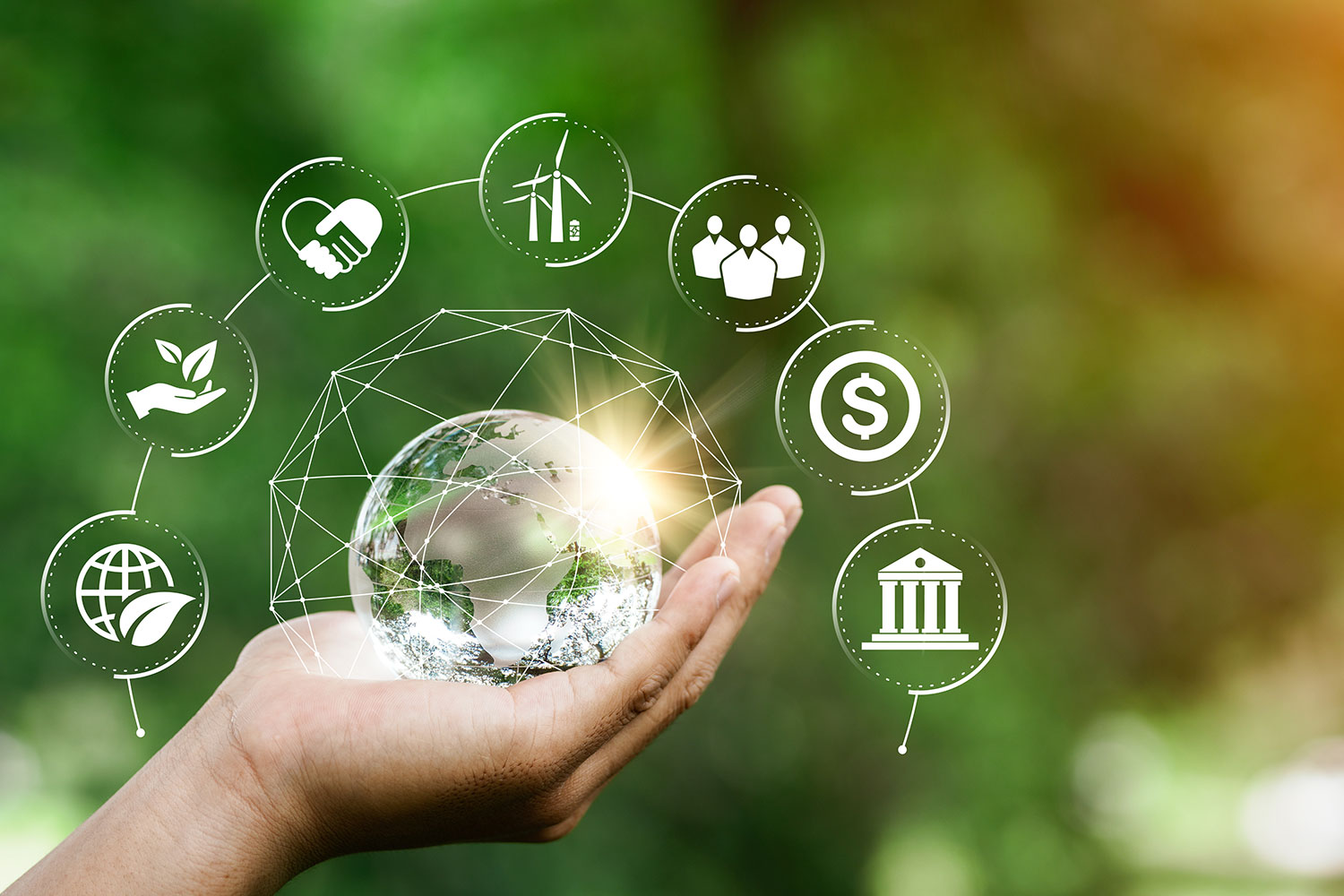
Accumulation of greenhouse gases from burning of fossil fuels, deforestation, agriculture, and industry are increasing global temperatures and changing weather patterns. Degradation of natural habitats adversely affect biodiversity. Pollutants from manufacturing are associated with human health issues. Food and water security along with socioeconomic disparity have created a complex worldwide crisis (see Fig 1) that requires immediate directives to mitigate negative consequences and provide the foundation for a long-term sustainable future. Green development has arisen as strategic solutions to address environmental concerns and the framework for economic progress through transition towards renewable energy and sustainable business (Shen 2025).

Figure 1. Theoretical nexus of environmental poverty and green growth (Shen 2025)
Development Policies
Economic growth, social equity, and environmental conservation are core tenets of sustainable development. Prominent challenges and imbalances factors remain due to inadequate recognition of the link between urban-rural regions (Han 2026). Policy documents have been recently introduced to dismantle this dichotomy and promote coordinated development. Integrated policies exert significant positive effects, create multiple regional pathways, significantly influence development, and generate positive spillover.
Global demand for sustainable development and green technology to reduce carbon emissions has intensified recently to a critical need from a life cycle perspective. Design strategies and construction practices direct influence building costs, energy performance, and carbon emissions, calling for more efficient means and sustainable methods (Zhang 2025). The process of life cycle assessment (LCA) alongside building information modeling (BIM) allows for complex analysis of design data to create accurate representations and calculate optimal solutions.
Regulation and Enforcement
Governments implement regulations to achieve policy objectives including control of buildings to maintain quality and safety in the public interest. New requirements are necessary to guide sustainable development, improve quality of life, and reduce stress from population growth (Mohammed 2017). Creating and enforcing these policies face technical, institutional and economical challenges along with societal and cultural barriers. Command and control, financial incentives, performance criteria, market regulation, and self-reporting are various means of enforcement. Ensuring compliance through regulation is a critical factor for functioning societies which rely on trust in governmental agencies.
The quality of governance determines the success of development policy when facing environmental decline, socioeconomic inequality, and weak institutions. These structure must be efficient, transparent, accountable, and participatory. Global framework outlined in the UN 2030 Agenda requires economic growth, resilient systems, environmental protection, and inclusive social programs (Das 2026). Nations with robust institutions are better equipped to build trust, mobilize capital, manage resources, and implement strategies, while instable, inefficient and corrupt governments distort allocations and weaken legitimacy.
References
Das, Pradip. (2026). Good Governance and Sustainable Development: Pathways, Principles, and Policy Imperatives. British Journal of Multidisciplinary and Advanced Studies, 7(1): 1-16. doi.org/10.37745/bjmas.0510.
Han, Tonglaga & Zhou, Ying. (2026). The Impact of Urban–Rural Integration Policies on Regional Sustainable Development. Sustainability, 18: 2784. doi.org/10.3390/su18062784.
Mohammed, Sawsan & Abdulridha, Ibtisam. (2017). Regulations Enforcement Mechanisms for Sustainable Housing Projects. Journal of Engineering, 23(7). doi.org/10.31026/j.eng.2017.07.03.
Shen, Lanjun. (2025). From Scarcity to Sustainability: Impact of Environmental Poverty on Green Growth in Developing Countries. Natural Resources Forum, 50: 925–949. doi.org/10.1111/1477-8947.70002.
Zhang, Xiaocun & Zhang, Jingfeng. (2025). Life Cycle Sustainable Design Optimization of Building Structural Components: A Hybrid Approach Incorporating Genetic Algorithm and Machine Learning. Sustainability, 17: 10449. doi.org/10.3390/su172310449.